When an aircraft moves on the ground, from the terminal to the runway or from the runway to the terminal, it is now quite common to taxi using only one engine instead of two.
Why? Because one engine is usually sufficient to move the aircraft on the ground, despite the asymmetry of thrust. In many cases, having both engines running produces more thrust than required, which can lead to unnecessary brake use and additional fuel consumption.
However, although single-engine taxi is now widely used, there is still debate about its real benefits. Some major industry stakeholders argue that the resulting fuel savings are limited, claiming that shutting down one engine can increase taxi time and therefore offset the benefit of the lower fuel flow.
At GH Aviation Consulting, we go beyond standard KPIs to help airlines assess fuel savings and identify best practices tailored to their operations. The approach presented here focuses on the main physical and operational drivers of taxi fuel consumption.
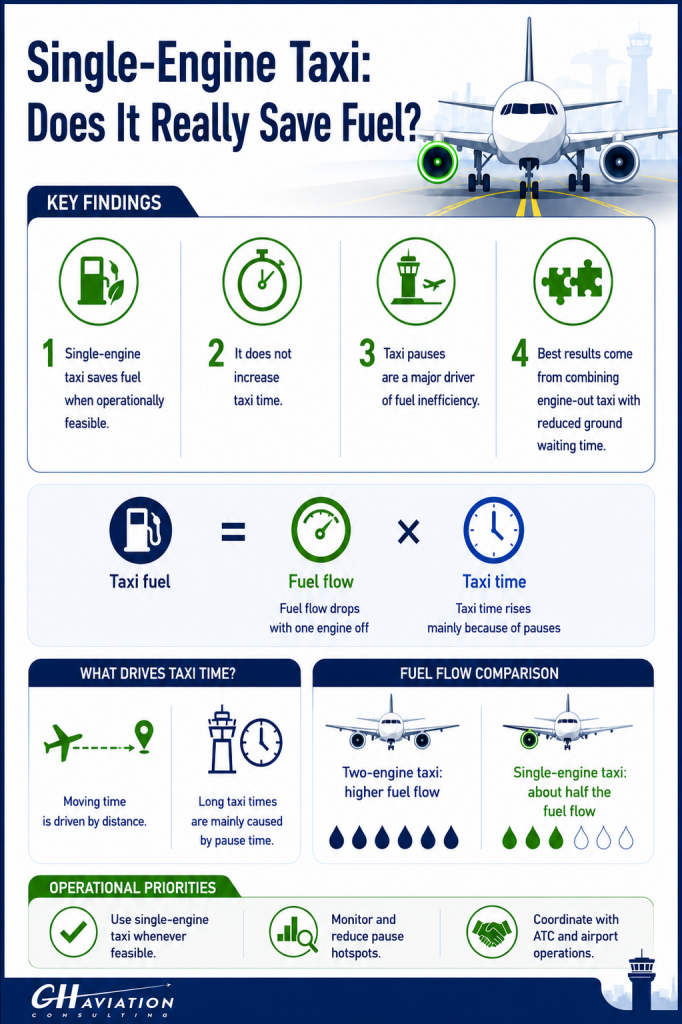
Our conclusions are:
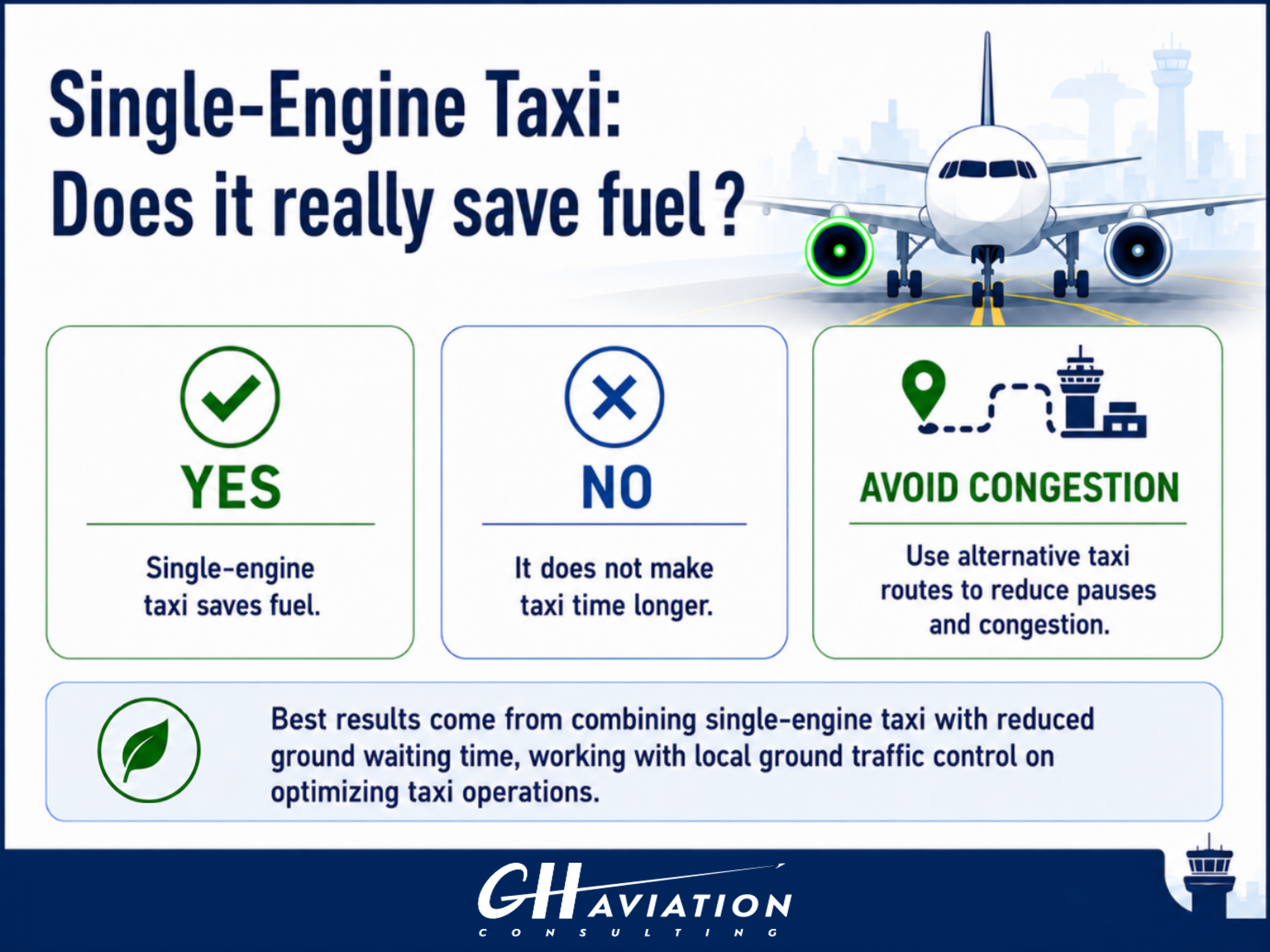
- Single-engine taxi procedures save fuel and should be applied whenever operationally feasible.
- Single-engine taxi does not lead to longer taxi times. Taxiing on one engine can be performed at the same speed as taxiing with two engines.
- Taxi pauses, usually driven by air traffic control and airport congestion, are a major driver of taxi fuel efficiency. Reducing waiting time on the ground is therefore a key lever for improving fuel efficiency.
The confusion in the industry comes from the fact that single-engine taxi is often used more frequently when taxi phases include a significant pause time. In other words, single-engine taxi does not make taxi time longer. Rather, when pauses are expected or occur during taxi, pilots are more likely to shut down one engine.
Taxi fuel is split in taxi fuel flow and taxi time
Taxi fuel is the result of the taxi fuel flow multiplied by the taxi time. When performing an analysis of taxi fuel, we typically recommend to tackle separately both drivers:
– Taxi time : we can wonder if taxi-in durations are driven by factors like route complexity and distance, pauses, or one-engine taxi usage.
– Taxi fuel flow : we can question whether one-engine taxi usage is really associated with lower fuel flow and evaluate the influence of other potential drivers such as landing weight and pause time.
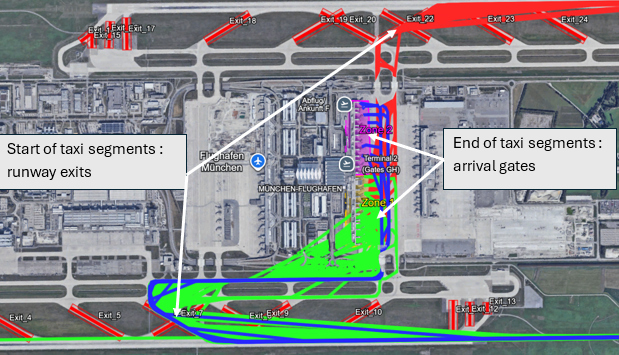
It is important to have a very clear definition of the taxi phase for this kind of analysis to avoid having distorted results. Although the taxi phase is considered for dispatch as the time between the landing and the arrival at the gate we recommend to limit the analysis to the time at which the aircraft leaves the runway to the time the aircraft is attached to the gate. This can typically be done using ADS-B data or QAR data.
Taxis can be classified by runway exit, gate number, moving time, pause time (time spent with the aircraft not moving).
Taxi time drivers
Once comparable taxi segments are defined, the first question is what drives taxi duration, beyond the obvious effect of taxi distance.
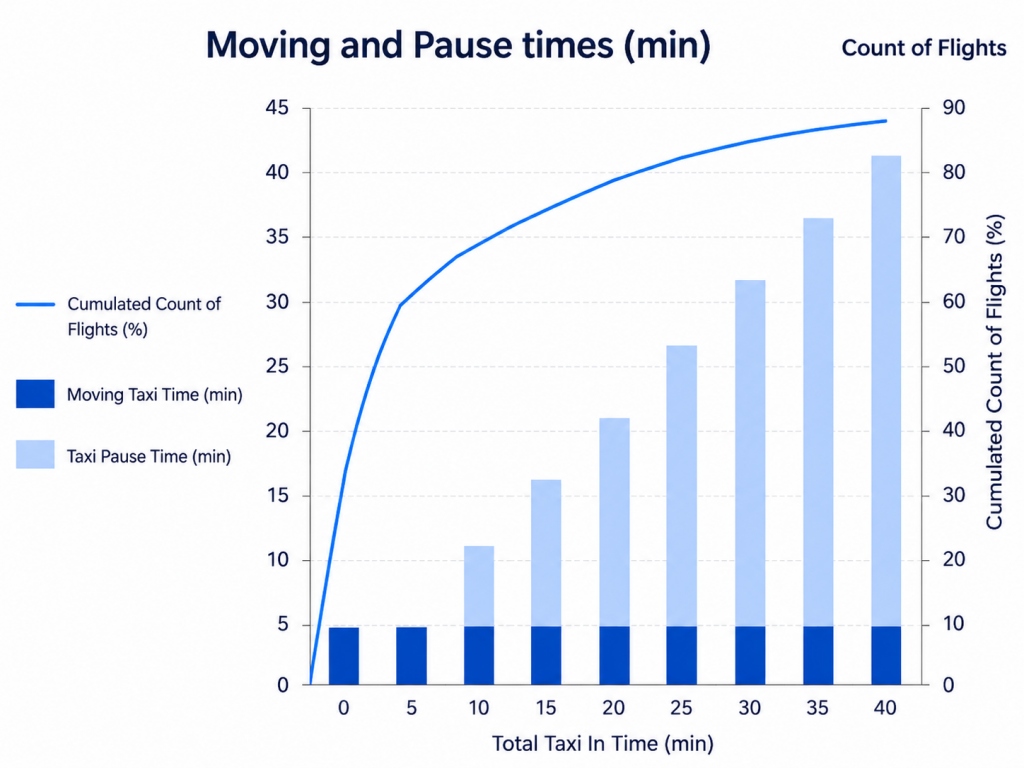
In typical taxi operations, most flights experience limited or no pause time, while a smaller share accumulates longer waiting periods. This varies with airports, but we can expect to have about 75% of the taxis done without any pause. We recommend to separate the taxi time between the time during which the aircraft is moving (Moving time) and the time during which the aircraft is stopped (Pause time). They are both driven by two different drivers.
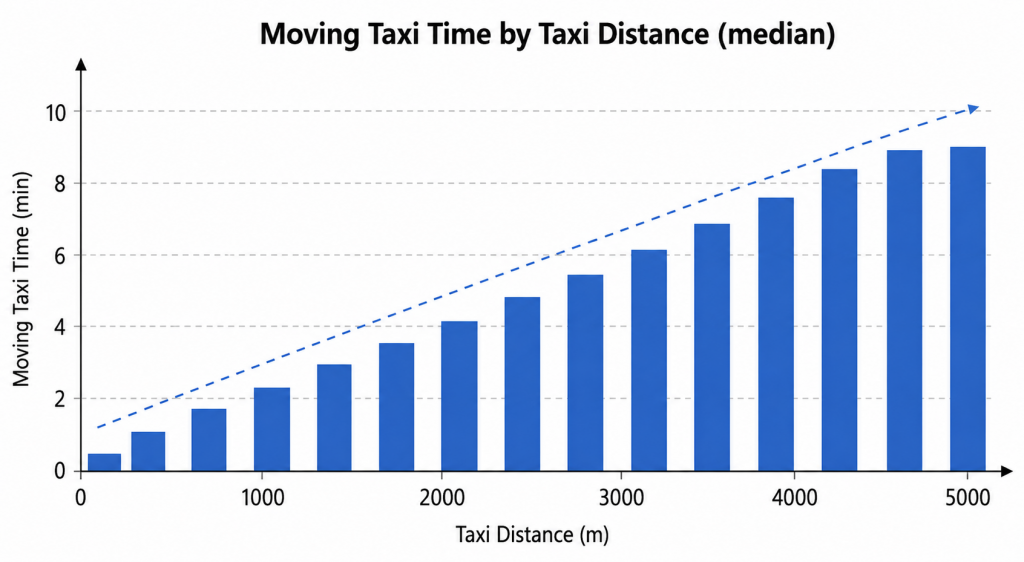
First, if we focus on the moving taxi time and plot it against taxi distance we are likely to get a figure like Figure 2 which shows that the moving taxi time is primarily governed by taxi distance. Longer taxi routes naturally require more moving time, assuming comparable taxi speeds and operating conditions.
Now, the total taxi time is made of the taxi “moving time” and the taxi “pause time”. If we plot the breakdown of the taxi time as a function of taxi time we typically get a figure like in Figure 3, which shows that the long taxi times are mainly due to long “pause” times and not to long “moving” times.
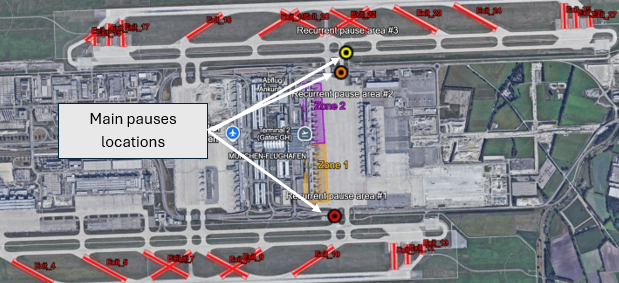
In a taxi fuel analysis deep dive we can even identify where these pauses occur. Spatial analysis of pause events provides an airport-specific view of where taxi-in interruptions most often occur. Once identified, these zones can be used as an additional operational layer when comparing possible taxi routes. In some airports, different taxi trajectories can lead from the same runway exit to the same arrival zone. In some airport layouts, a slightly longer route may still be operationally preferable if it reduces exposure to recurrent taxi interruption areas. A bit like using Waze for taxi. This type of analysis can support discussions between airlines, airport operations and ground traffic control to improve taxi fluidity.
So taxi time is a function of taxi distance and the pause time due to congestion of the airport space.
Now is there any effect of engine out taxi procedures on taxi time? The answer is no. A typical curve of speed during the moving time as a function of engine-out ratio (part of the taxi time performed on one engine) would show a steady trend.
There is no influence of engine out procedure on the taxi speed when the aircraft is moving.
Finally, the conclusion is that taxi time is mainly driven by pauses that occur along the trajectory from the runway exit to the arrival zone and by the distance of the followed path responsible for the time of moving taxi.
Taxi Fuel Flow drivers
Now let’s look at the factors that influence the taxi fuel flow.
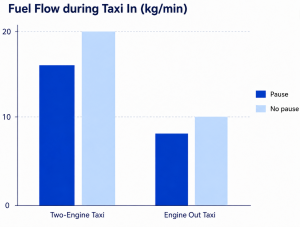
If we plot the average fuel flow during taxi we see something like in Figure 6. It can be observed that higher EOT usage is associated with lower fuel consumption. When single-engine taxi is applied during a large share of the taxi phase, the fuel burn rate is expected to decrease substantially.
Pause behaviour also affects the fuel burn-rate. When the aircraft is stopped or moving slowly, fuel consumed per minute may differ from normal moving taxi. However, this effect must be interpreted carefully: a lower apparent fuel flow during pauses does not necessarily mean lower total taxi fuel, because pauses also increase taxi time. These effects remain secondary compared with Engine-Out Ratio, which is the primary driver of taxi fuel burn rate.
Landing weight and moving taxi speed may remain useful control variables, but according to our experience they are not expected to dominate the fuel burn-rate mechanism compared with engine configuration.
Overall, the fuel burn-rate analysis suggests two contributors: the engine out procedure cuts the fuel flow by about half, while pauses also tend to reduce the apparent burn rate (with a much lower order of magnitude than shutting down an engine).
Engine Out Adoption
The use of Engine-Out Taxi procedure is strongly linked to the operational taxi context. However it is usually typically observed that flights with longer or more frequent pauses tend to show a higher Engine-Out Ratio (time % of the taxi during which the engine is shut down). This suggests that pause phases create more opportunities for crews to apply an engine out procedure.
High Engine-Out Ratio may therefore be observed on longer or more interrupted taxi phases, but this does not mean that Engine-Out Taxi causes taxi time to be longer. The relationship is more likely the opposite: longer or interrupted taxi phases make Engine-Out Taxi procedure more relevant and provide more time to apply it.
Conclusion
Taxi fuel consumption is governed by three main drivers: taxi distance, Engine-Out Ratio and taxi pause time.
Distance primarily drives moving taxi time, while pauses can increase significantly the total taxi time. Shutting down one engine directly reduces the fuel burn rate during the portion of taxi performed in single-engine configuration.
One important point must be emphasized : Engine-Out Taxi is not the cause of longer taxi times. Rather, longer or more interrupted taxi phases provide more opportunities to apply EOT. This explains why high EOT usage is often observed on flights with longer taxi duration or more pause time.
From an operational perspective, fuel savings can therefore be improved through two main levers:
– The first is to increase Engine-Out Taxi usage when operationally feasible.
– The second is to reduce unnecessary pause times, in coordination with ground traffic control and airport operations.
Pause hotspots can help identify where taxi interruptions occur most often and where alternative routings or improved sequencing could reduce waiting time.