
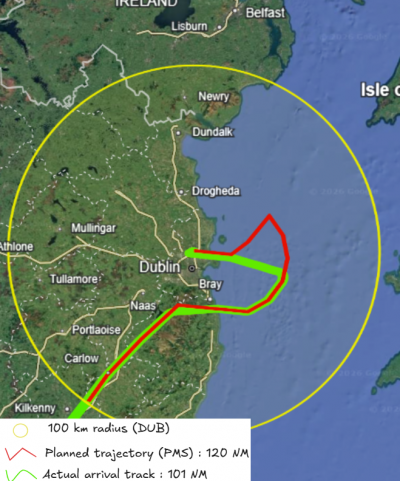
What if an A320 could burn 20 kg less fuel per flight, without any operational changes?
At first glance, 20 kg may seem marginal. Yet at scale, such improvements represent significant savings for airlines. Achieving them, however, does not necessarily require new procedures or technologies — but rather a better understanding of the trajectory that the aircraft actually fly and a better estimate of the fuel needed for the flight.
Through our consulting missions we have realised some airlines plan their flights according to approach procedures that do not reflect what aircraft actually fly, in particular when the airport uses sophisticated approach patterns such as Point Merge Systems or Trombone systems. Improving this is an opportunity for fuel savings. Aligning planning with actual flights can indeed unlock immediate fuel savings.
Background
The amount of fuel carried during the flight has an impact on the actual fuel burnt as the heavier the aircraft, the more fuel it burns. Airlines have to carry enough fuel to operate a safe flight according to the regulation. But any excess fuel uplift — fuel loaded but not actually required — increases aircraft weight and results in additional fuel burn throughout the flight: carrying unnecessary extra fuel leads to burning more fuel.
In this context, arrival procedures (STARs and sequencing techniques such as Trombone or Point Merge Systems) are designed to structure traffic and improve predictability. These procedures typically rely on predefined paths or holding shapes with multiple waypoints, allowing air traffic control to sequence aircraft efficiently.
However, in practice, actual trajectories are often driven by real-time ATC instructions. They are frequently shortened, vectorized or adapted in real-time. This creates a fundamental gap between the planned trajectory and the route actually flown. And an excess fuel uplift that can be saved.
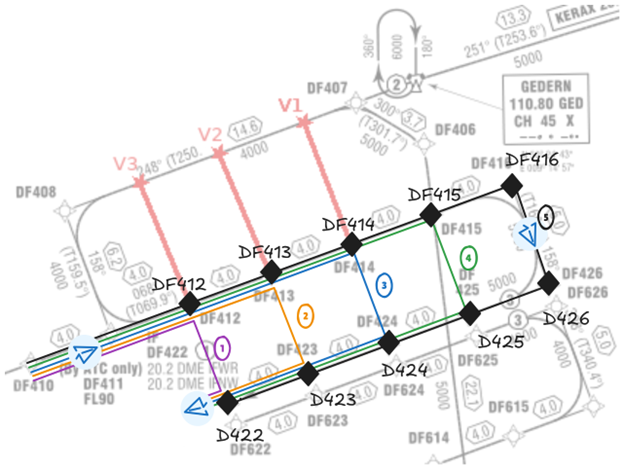
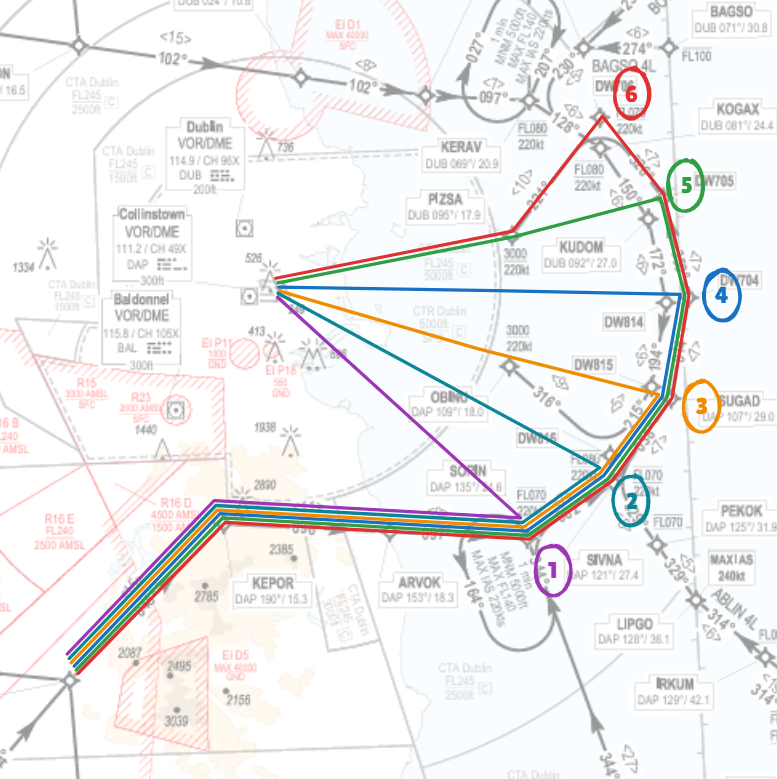
The Challenge and Our Approach
From a fuel planning perspective, the challenge is not only to understand procedures, but to identify the most probable arrival trajectory and use it at flight planning stage.
EASA fuel planning guidance explicitly requires operators to account for the expected arrival routing when calculating trip fuel : ‘taking into account the expected arrival routing’ (AMC1 CAT.OP.MPA.181). In practice, this means that fuel planning should reflect the most likely operational trajectory rather than systematically relying on full or pessimistic procedures. This means having statistics available.
In reality, identifying this expected trajectory is complex. Multiple procedures may exist for a single airport and operational deviations are frequent.
To address this, GH Aviation Consulting developed a data-driven methodology to identify actual arrival trajectories based on large-scale flight data. By combining matching logic, which compares trajectories to published procedures using spatial tolerance, with geometry-based detection capable of identifying trajectory shapes such as arcs or trombone patterns, the method enables a robust and reliable identification of actual flown approaches, even in complex and highly dynamic operational environments.
Key Results & Impact on Fuel Planning
Analysis of case studies shows that full published procedures – meaning the complete arrival path with all intermediate waypoints and no ATC-guided shortcuts – are rarely flown. Whether considering trombone patterns or PMS arcs, most flights only follow a limited portion of the procedure before being guided to final approach by ATC. As a result, actual arrival trajectories are consistently shorter than the full procedure published trajectory sometimes used for worst case fuel planning by airlines. This discrepancy is reflected in key metrics such as for instance the distance flown within a 100 km radius of the airport, which averages around 83 NM in Frankfurt compared to approximately 121 NM for the full published procedure.
Longer assumed trajectories at planning stage lead to systematic overestimation of planned flight distances and, consequently, higher planned fuel consumption. The resulting excess fuel uplift increases aircraft weight, which in turn leads to additional fuel burn during the flight due to the cost of weight effect. In practical terms, this can translate in Frankfurt into an uplift saving of approximately 320 kg of fuel per flight for an A320, and up to 950 kg for an A330 when planning is aligned with actual flown trajectories. This reduced uplift also lowers aircraft weight, generating additional savings of around 20 kg per flight for an A320 and up to 320 kg for an A330. Overall, the aircraft is lighter and burns less fuel.
Broader Applicability
This method is not limited to PMS or trombone equipped environments. At any airport, multiple arrival options with varying lengths coexist. Identifying the most probable arrival trajectories through data analysis is a key step to implement more accurate and optimized fuel uplift strategies and to move away from worst-case planning.
Takeaways
Because operational reality differs from published procedures, identifying actual flight trajectories is essential to bridge the gap between designed published procedures and actual operations. Data-driven analysis then becomes a powerful lever to align fuel planning with actual operations, reduce unnecessary fuel uplift, and improve overall fuel efficiency.
Ultimately, optimizing fuel efficiency is not only about aircraft performance, but also about planning the right approach trajectory. Understanding what aircraft actually fly is therefore a prerequisite to unlocking meaningful and scalable fuel efficiency gains.
Looking at other applications, the KPIs and the methodology we have developed could help assess the efficiency of an airspace control system. Airports can be benchmarked, airlines also. From our experience, there are big differences between perception and quantified impacts. We believe for instance having statistics on actually flown approaches is useful to airlines when discussing with the ANSPs.
Interested in evaluating the savings potential at your airline? Let’s have a chat!
